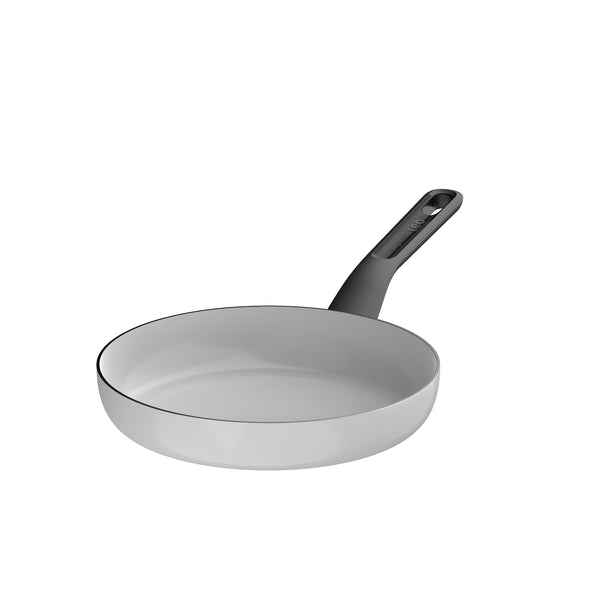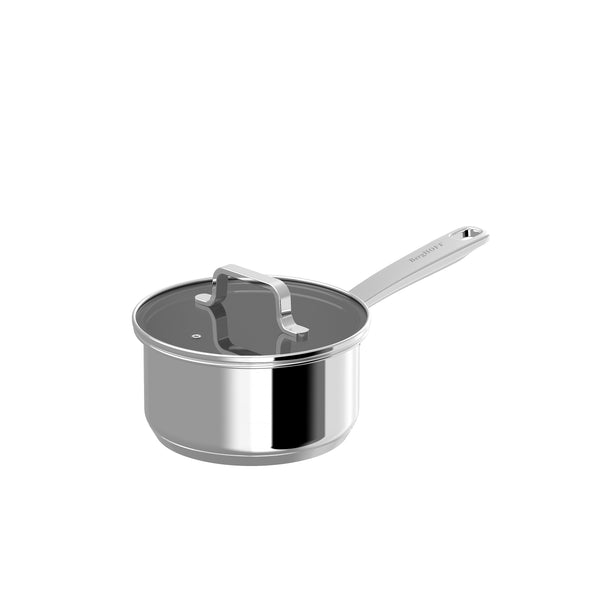

A sauté pan has tall, straight sides and usually comes with a lid, while a frying pan has low, sloping sides and no lid. That one difference in shape decides what each pan does best. Reach for a frying pan when you want to sear, brown or flip, and for a sauté pan when there's liquid involved: sauces, shallow braises and one-pan dinners that need room and a lid.
Below you'll find the two pans side by side, what each one is good at and which to buy first if you only want one. At the end there's a short note on two other specialists, the grill pan and the omelette pan.
Sauté pan vs frying pan at a glance
| Frying pan | Sauté pan | |
|---|---|---|
| Sides | Low and sloping | Tall and straight |
| Lid | Usually sold without | Usually included |
| Handles | One long handle | A long handle, or two short ones on larger models |
| Capacity at 28 cm (BergHOFF examples) | About 3 L | 4.7–5.5 L |
| Weight at 28 cm (BergHOFF examples) | About 1.3 kg | About 2–2.7 kg |
| Best for | Searing, eggs, pancakes, anything you flip | Sauces, shallow braises, risotto, curries, one-pan meals |
The numbers come from our own 28 cm pans. The Helix stainless steel frying pan holds 3.15 litres, while the Helix stainless steel sauté pan 28 cm is 9.2 cm deep and holds 5.5 litres. Same diameter, a lot more room.
What a sauté pan does well
Straight sides give you two things a frying pan can't. First, the whole base is usable: there's no sloping edge, so more food sits flat on the hot metal. Second, there's room for liquid. You can brown chicken thighs, pour in stock or wine, put the lid on and let it simmer without anything slopping over the rim.
That makes a sauté pan the natural choice for:
- pan sauces and tomato sauces that need to reduce;
- shallow braises, such as chicken in wine or meatballs in sauce;
- risotto, paella-style rice and curries;
- finishing pasta in its sauce, or cooking a large batch of greens that start out bulky;
- shallow frying, where the tall sides keep splashes off the hob.
Eggs cooked in sauce are a good example: our one-pan shakshuka needs exactly that mix of width, depth and a lid.
The lid matters more than you might think. It traps steam so food cooks through gently, and some lids do more than that. The Phantom non-stick sauté pan 28 cm has a straining lid and small bumps on the inside that drip condensation back onto the food.
The name is a little misleading, by the way. "Sauté" comes from the French for "jump", but tossing food with a flick of the wrist is easier in a frying pan, because the sloping sides help it flip back in.
What a frying pan does better
A frying pan is built for dry heat. The low, flared sides let steam escape quickly, so the surface of the food stays dry enough to brown. That's what gives a steak its crust and fried potatoes their colour. In a deep pan, the same food is more likely to sweat than sear.
The low sides also make it easy to get a spatula under an egg, a fish fillet or a pancake, and a frying pan is lighter, so it's quicker to heat and easier to handle. For everyday cooking for one to four people, it's the pan most kitchens use most. If you're choosing one, our guide on how to choose a frying pan covers materials, sizes and hobs.
Which one should you buy first?
For most kitchens, the frying pan comes first, simply because it's used every day. Add a sauté pan when you notice you keep reaching for a pot to finish what you started in the frying pan. A few rules of thumb:
- You mostly fry, sear and cook eggs: a frying pan is enough.
- You cook saucy dishes, rice or braises a few times a week: a sauté pan will earn its place.
- You only have room for one pan: a sauté pan is the more versatile of the two, because it can fry as well, just a little less nimbly.
- You cook for a family or for guests: the extra volume of a sauté pan makes one-pan meals for four or more much easier.
Some people call a sauté pan a "deep frying pan" or a "frying pan with a lid", and in the shop that's a fair way to think of it. If what you really need is a heavy pot for long, slow cooking, a casserole or Dutch oven is the better fit; see saucepan vs casserole vs stockpot.
What to look for in a sauté pan
Material
Stainless steel is the choice if you want to brown meat properly first and make the sauce in the same pan, and it can go in the dishwasher. Non-stick is easier for rice, eggs and delicate fish, needs less fat and is best washed by hand. Our sauté pans come in both: Helix in stainless steel, and Phantom, Stone+ and Balance with the ceramic CeraGreen coating, which is PFAS-free according to the manufacturer.
Size and capacity
A 26 cm sauté pan, like the Balance models with 2.9 litres, suits two or three people. A 28 cm pan with 4.7–5.5 litres is the size to pick if you cook for a family or like leftovers.
Handles and lid
Two short handles make a full, heavy pan easier to lift and take less room in the oven. Check the oven limit for the pan and the lid separately: the Helix pan goes up to 250 °C, but its glass lid only to 180 °C, and the Phantom and Stone+ pans go up to 230 °C once you take off their silicone handle sleeves. A glass lid lets you keep an eye on the food, while a straining lid saves you a colander.
Hob
All our sauté pans work on every type of hob, including induction.
Two more specialists: grill pan and omelette pan
A grill pan has raised ridges that lift the food off the base, leave grill marks and let the fat run away. It's the indoor answer to the barbecue for steak, chicken, halloumi and vegetables. We have three 26 cm grill pans: the Stone+ and Helix with a non-stick coating, and the Graphite in enamelled cast iron, which holds on to its heat.
An omelette pan is the opposite of a sauté pan: a low rim and gently curved sides, so an omelette slides out and folds neatly. Our 25 cm omelette pans are in the Graphite and Balance ranges. For flat, low-rimmed pans in more detail, read our pancake pan guide.
What are you cooking?
If you'd rather start from the dish than the pan, these collections group the right pans and tools together:
- pans for steak, from stainless steel frying pans to a cast iron grill pan;
- pans and pots for stews, where our sauté pans sit alongside shallow casseroles;
- pans for eggs and omelettes, including the omelette pans above.
For a pasta night, our spaghetti carbonara recipe shows why the sauce comes together best in a wide sauté pan off the heat.
Frequently asked questions
Can I use a sauté pan instead of a frying pan?
Yes, for most things. It fries and sears well, but the tall sides trap a bit more steam and make flipping harder, and it's heavier to handle.
Is a sauté pan the same as a deep frying pan?
Not quite. Both are deeper than a standard frying pan, but a sauté pan has straight sides, usually a lid and often two handles. A deep frying pan typically keeps sloping sides and a single long handle.
What size sauté pan should I buy?
26 cm for two or three people, 28 cm for a family. Check the capacity in litres, as the depth makes a big difference.
Can a sauté pan go in the oven?
Most can, but check both the pan and the lid. Our sauté pans are oven-safe to 180–250 °C depending on the model, and glass lids usually have a lower limit than the pan.
Is a skillet the same as a frying pan?
Yes. "Skillet" is the American word for a frying pan, and it's often used for cast iron pans in particular.